
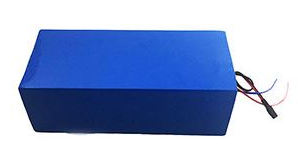
48V 21Ah Automated Guided Vehicle AGV Battery
Battery model: 3.2V IFR26650-3000mAh
Assembly way: 15S7P-26650
Battery voltage: 48V
Battery capacity: 21Ah
Internal resistance: ≤150mΩ
Continuous discharge current: 42A
Max. discharge current: 120Ah
Standard charge voltage: 55V
Charging temperature: 0~45℃
Discharging temperature:-20~60℃
Battery pack size:length*width*thickness=440*200*73mm
Wire model: 1007/14awg, 300±5mm
Application: intelligent cargo handling robotics, industrial robotic, AGV car, ect.
AGV stands for: Automated Guided Vehicle, referred to as AGV. Currently, the most common application is: AGV handling robot or AGV trolley. The main function is concentrated on automatic logistics transfer. The AGV handling robot automatically transports items to designated locations through special landmark navigation.
AGV in manufacturing industry: AGV handling robots in the market are mainly used in manufacturing material handling. AGVs are used in manufacturing applications to complete material handling tasks efficiently, accurately and flexibly. And multiple AGVs can form a flexible logistics handling system, and the handling route can be adjusted in time with the adjustment of the production process.
AGV in special industry: In the military, it integrates other detection and disassembly equipment based on the automatic driving of AGV, which can be used for battlefield demining and position reconnaissance.
Lithium batteries are more and more used in the AGV industry. There are several reasons why Lithium batteries are acquiring market share. In some cases, such inductive wireless charging, Lithium batteries are the best option. Contactless charging technology reaches near 95% efficiency and needs batteries able to receive a big amount of energy in fast charging cycles.
Longer cycle time
For a given depth of discharge (DOD), Lithium batteries grant more recharging cycles so more life.
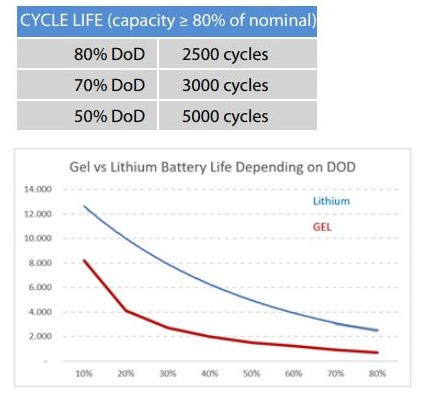
So, if you always discharge the AGV battery to 50% of its capacity, SLA (GEL/AGM) had around 1500-1800 recharging cycles lifetime. With the same 50% DOD, the Lithium battery lasts for 5000 cycles.
Deepest Depth of Discharge (DOD)
In order to have a good cycle life for an AGM or GEL battery you should keep DOD close to 40%-50%. It means that if you have a 100 Ah battery you can use around 40 or 50 Ah before you need to recharge. Lithium batteries can handle DOD of 80% maintaining excellent battery life (still close to 2500 cycles). With the same 100 Ah battery, you can use 80 Ah before you need to recharge. It means more time availability for your AGV to perform missions rather than"losing" time for recharging.
Lithium batteries efficiency is higher
Lithium batteries are more efficient. Lithium batteries efficiency is near 95% while in Lead batteries such AGM or GEL, it is close to 80-85%. Roughly, it means that if you charge 1000 watt, a lithium battery loss around 50 watts (you really get 950 watts). Lead battery instead, loses 15-20%, it means that you will need more time to fully charge your AGM/GEL battery.
Lithium batteries charge rate is faster
While charging, you can pump more Amperes/hour without compromising battery life, so again, you can charge battery much faster. In AGM/GEL batteries you needed around 4-5 hours to charge from 60% to 100%. With lithium you only need close to 1,5 hours. This feature is essential for AGV systems with opportunity charging. With Lithium batteries you should only need 10% of AGV time, it means that your AGVs are available more time for performing missions and transporting materials.
Higher Energy Density
More energy available in a given volume. In other words, the same power and less weight or the same weight and more power. We can consider that the energy density in Lithium batteries is three times higher than in the lead batteries.